
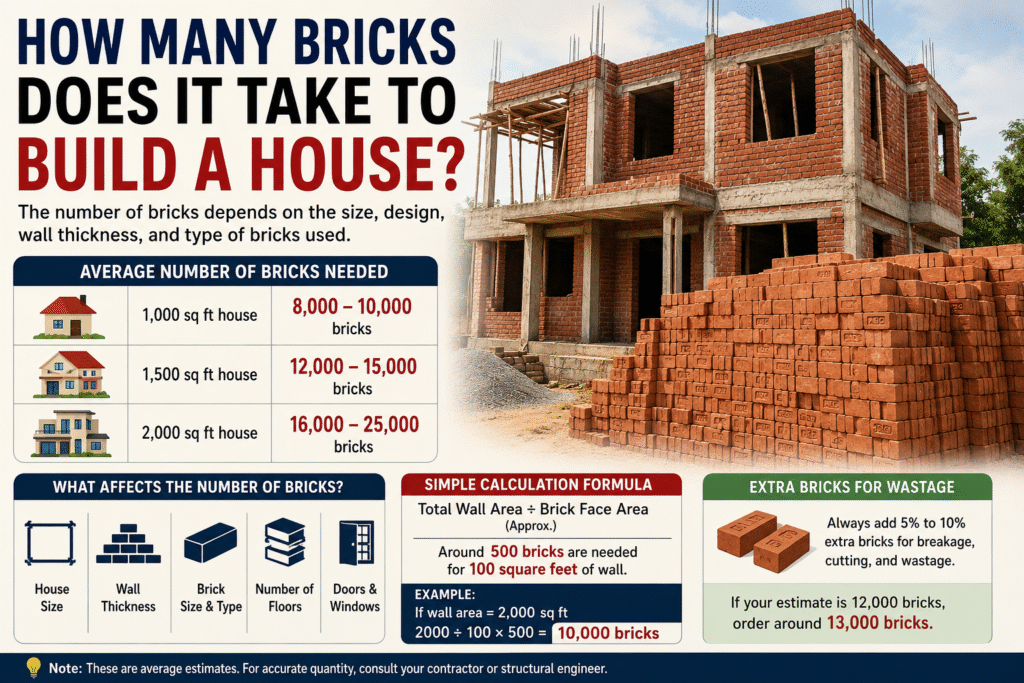
If you’ve ever looked at a newly constructed home and wondered, “How many bricks does it take to build a house and how to calculate bricks for any wall?” — you’re not alone. It’s one of the most common questions homeowners, builders, and even curious buyers ask before starting construction.
The answer, however, isn’t as simple as giving one exact number.
The total number of bricks needed depends on several factors like the size of the house, wall thickness, ceiling height, architectural design, and the type of bricks being used. A small single-floor home may require only a few thousand bricks, while a large multi-story house can easily consume tens of thousands.
Let’s break it down in a simple way so you can estimate brick requirements more accurately.
Average Number of Bricks Needed for a House
On average:
- A 1,000 sq ft house may require around 8,000 to 10,000 bricks
- A 1,500 sq ft house may need approximately 12,000 to 15,000 bricks
- A 2,000 sq ft house often uses 16,000 to 25,000 bricks
These are rough estimates for standard residential construction using traditional clay bricks.
The number can increase if:
- The design includes boundary walls
- Interior partition walls are thicker
- Decorative brickwork is added
- The house has multiple floors
What Determines How Many Bricks a House Needs?
Several construction elements affect the final brick count.
1. House Size
Naturally, bigger homes need more bricks. A compact 2-bedroom home will require far fewer materials than a luxury villa with multiple rooms and extended walls.
The total built-up area plays the biggest role in estimating brick quantity.
2. Wall Thickness
Wall thickness significantly changes brick usage.
For example:
- A 4.5-inch wall uses fewer bricks
- A 9-inch wall nearly doubles the requirement
External walls are usually thicker for strength and insulation, while internal walls may be thinner.
3. Brick Size
Different countries and manufacturers produce bricks in different dimensions.
Common brick sizes include:
- Standard clay bricks
- Modular bricks
- Fly ash bricks
- Concrete blocks
Larger blocks reduce the total number required because each unit covers more area.
4. Number of Floors
A double-story house requires additional structural walls, support systems, and partitions. That means more bricks compared to a single-floor construction.
5. Doors and Windows
Houses with large windows and open spaces may actually require fewer bricks because those sections reduce wall area.
Simple Brick Calculation Formula
Builders often estimate bricks using wall area.
A commonly used method is:
Total Wall Area ÷ Brick Face Area
For standard calculations, many contractors use a quick rule:
- Around 500 bricks are needed for 100 square feet of wall
This estimate includes mortar joints.
For example:
If a house has 2,000 square feet of wall area:
2000÷100×500=100002000÷100×500=10000
That means approximately 10,000 bricks may be required.
How Many Bricks for a 3-Bedroom House?
A standard 3-bedroom house typically requires:
- 10,000 to 17,000 bricks
The final number depends on:
- Layout complexity
- Ceiling height
- Exterior design
- Garage or balcony additions
Modern architectural styles with large glass sections may reduce brick usage slightly.
Brick Wastage Should Always Be Included
One mistake many first-time builders make is ordering the exact estimated quantity.
In reality, some bricks:
- Break during transportation
- Crack while cutting
- Get damaged on-site
That’s why professionals usually add:
- 5% to 10% extra bricks
So if your estimate is 12,000 bricks, ordering around 13,000 is often safer.
Clay Bricks vs Concrete Blocks
Traditional clay bricks are popular, but many modern homes now use concrete blocks or AAC blocks.
Here’s the difference:
| Material | Quantity Needed | Construction Speed |
|---|---|---|
| Clay Bricks | Higher | Slower |
| Concrete Blocks | Lower | Faster |
| AAC Blocks | Much Lower | Very Fast |
Because blocks are larger, fewer units are needed to complete the same wall area.
Can You Estimate Bricks Without a Builder?
Yes, you can get a rough estimate yourself if you know:
- Total built-up area
- Wall dimensions
- Brick type
- Number of floors
However, for accurate planning, a contractor or structural engineer should verify calculations before purchasing materials.
Final Thoughts
So, how many bricks does it take to build a house?
For most residential homes, the answer usually falls somewhere between 8,000 and 25,000 bricks, depending on the house size and construction style.
A small home may need only a few thousand bricks, while a large custom-designed house can require much more. Factors like wall thickness, floor count, brick type, and architectural details all influence the final quantity.
Before starting construction, always calculate carefully and include extra bricks for wastage. A proper estimate helps avoid delays, reduces material shortages, and keeps your construction budget under control. For more such news & updated visit hzoy.in